Solving air chemistry puzzles from the sky
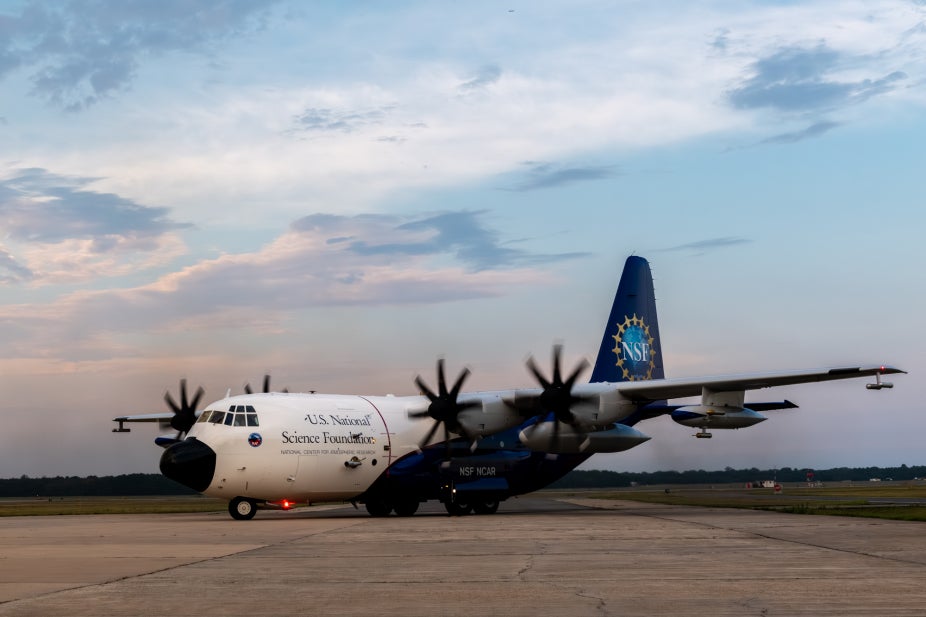
The NSF NCAR C-130 used in the GOTHAAM field project.
Chris Rodgers, Code 10 Photography
7:00 – 8:30 pm MDT
It’s a bird. It’s a plane. It’s a laboratory on a plane! By flying directly through smoke plumes, urban smog, and polluted skies, airborne laboratories help researchers piece together the complex puzzle of what's in the air we breathe and what we can do to improve it.
In this Explorer Series lecture, researchers Alessandro Franchin, Teresa Campos, and Eric Apel from NSF NCAR’s Atmospheric Chemistry Observations & Modeling (ACOM) laboratory will share discoveries from recent airborne field projects. They will highlight cutting-edge airborne instruments, satellite observations, and atmospheric models, and how those tools can inform policies that protect the air we breathe and deliver actionable air quality science.
Eric Apel
Dr. Eric Apel is a scientist and head of the Experimental Science Section at the NSF National Center for Atmospheric Research (NSF NCAR), in the Atmospheric Chemistry Observations & Modeling (ACOM) Laboratory. He earned his PhD in physical chemistry from the University of California, Irvine and has more than 35 years of experience studying the chemistry of Earth’s atmosphere. His research focuses on measuring trace gases in the air - especially volatile organic compounds - from both ground and aircraft-based platforms and understanding how they contribute to air pollution, including ozone and fine particulate matter (PM), along Colorado’s Front Range and beyond. His work also includes probing the sources and distribution of hazardous air pollutants and the chemical composition of wildfire smoke. Before joining NCAR, Dr. Apel was a Director’s Funded Postdoctoral Fellow at Los Alamos National Laboratory and later worked as a senior research chemist in industry.
Teresa Campos
Dr. Teresa Campos is an NSF NCAR Scientist in the ACOM and Earth Observing Laboratories. She is most interested in carbon cycle science and supports the University Atmospheric Science community funded by the NSF Facilities for Atmospheric Research and Education Program. She has led measurements of carbon monoxide, carbon dioxide, methane, nitrous oxide, water vapor and ozone on airborne experiments all over the world during her 35 year NSF NCAR tenure. As an NSF NCAR Advanced Study Program postdoctoral fellow, she made measurements of formaldehyde and nitric acid during the MLOPEX-II ground field experiment. She studied Analytical Chemistry, earning a PhD from Purdue University and a BS from Indiana University.
Alessandro Franchin
Dr. Alessandro Franchin is a Scientist at the NSF National Center for Atmospheric Research (NSF NCAR), in the Atmospheric Chemistry Observations & Modeling (ACOM) Laboratory. With over 15 years of experience in experimental atmospheric science, his research focuses on airborne and field measurements of reactive trace gases (NOx, ozone) and aerosols, with applications to ozone chemistry, aerosol formation, and atmospheric fluxes. Prior to joining NCAR, he was a Research Scientist at CIRES/NOAA and conducted his doctoral research at the University of Helsinki. He holds a PhD in Physics from the University of Helsinki, Finland and MS and BS degrees in Physics from the University of Milan, Italy.